
Special Manufacturing Techniques for Stainless Steel Insulated Bottles
Most factories work with the same set of standard processes. This page covers three techniques where that is not true — 3D UV digital printing for full-wrap multi-colour decoration on small runs, dishwasher-safe powder coating for bottles that have to survive real dishwashing cycles, and genuinely lead-free vacuum sealing for markets that are tightening lead limits. Each section explains what the technique changes, what it requires in production, and what it means for your order.
3D UV Digital Printing for Bottle Decoration
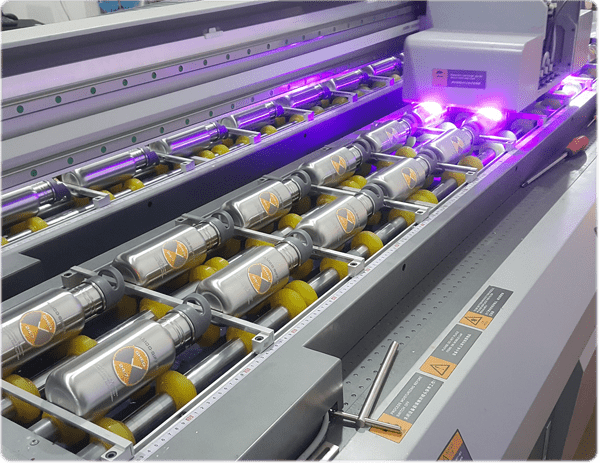
For drinkwares industry, 3D UV digital printing is a new printing technology. It’s suitable for overall multi-colors printing based on small quantity of products. With advantage of no set up charge, low production MOQ, it’s very suitable for small quantity of multi-colors printing for bottles.
Traditional heat-transfer printing need $500-700 to set up a printing plate, so it’s not economical to print hundreds of bottles by heat-transfer printing. While, 3D digital printing don’t any set up charge.
And there’s 3D effect on the printing. You may feel the printing by your finger. This is also a special feature different form other type of printing.
The advantages of 3D UV digital printings on stainless steel drinkwares:
1. Multi-colour artwork in one pass
3D UV digital printing reproduces full-colour (CMYK) designs and photographic patterns directly on the shell, so gradients and detailed artwork that would need several screens or plates in other processes can be produced in a single run.
2. No setup charge
There is no plate or screen to make, so there is no setup fee to start a design. This is the main cost difference against traditional heat-transfer printing, where plate setup typically runs around $500–600 before any bottles are produced.
3. Low printing MOQ
Because there is no setup cost to amortise, production can start from around 100 pcs. This suits test orders, limited editions, and brand sampling.
4. Full-wrap coverage
The print can cover the whole bottle as a continuous wrap rather than a panel on one side, which is what makes photographic and edge-to-edge designs possible.
Dishwasher-Safe Powder Coating
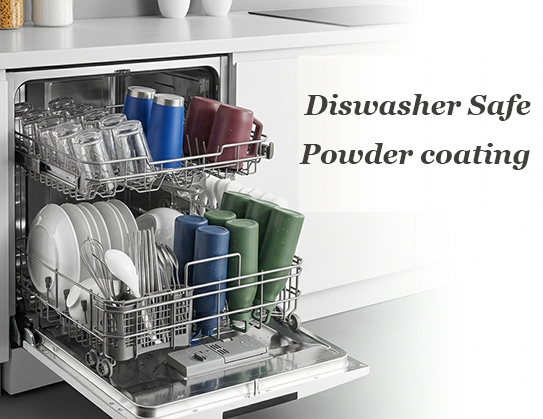
Here is the truth: Many powder-coated bottles on the market do not actually pass dishwasher testing, because standard powders are not formulated for that heat and chemistry. Hono Housewares produces powder-coated insulated bottles that do pass. It comes down to material selection and process control, and we verify both with regular dishwasher testing on production batches.
Dishwasher testing is not as simple as it sounds — especially for powder-coated bottles. The solution is not complicated, but it requires discipline and the right materials.
How to make water bottle with dishwasher safe powder coating?
1. Use a high-temperature-resistant powder
Replace standard powder with dishwasher-grade high-performance epoxy or super-durable polyester powder, and check the glass transition temperature (Tg). Specify powders with Tg above 120°C. They cost a few thousand more per tonne, but they are what keeps the order from coming back.
2. Control the coating thickness
The target film thickness is 60–80 μm. Below that, the coating does not give enough protection. Above it, internal stress builds up and the film can crack.
3. Optimise curing conditions
This is where most failures start. Use an oven temperature tracker to confirm that the bottle body itself — not just the oven air — reaches and holds around 200°C for at least 12 minutes. If the temperature is too low or the time too short, the powder does not fully cross-link, and the coating fails as soon as it meets a dishwasher.
For more knowledge about this dishwasher safe testing for water bottles, you may check our post: Dishwashing Testing for Insulated Water Bottle.
Lead-Free Vacuum Sealing
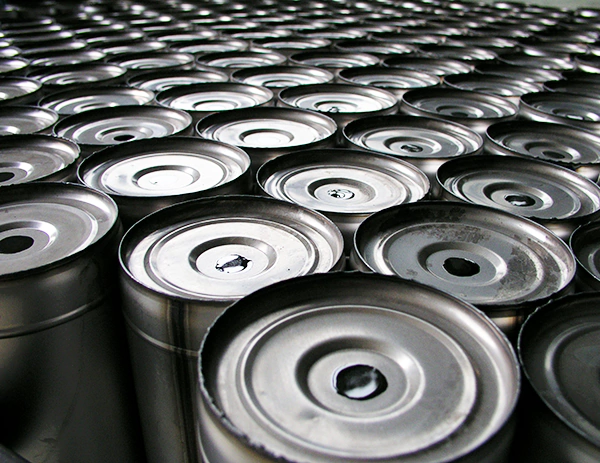
Lead exposure in insulated bottles is a growing concern, both from the base cap and from lead used during manufacturing. Demand for genuinely lead-free bottles is rising as more markets tighten their limits.
As a professional supplier of stainless steel insulated water bottles, we see the market shifting. We have plenty of experience producing standard food-safe bottles, but we also have the capability to handle genuine lead-free orders for clients who require it. It’s a different process, but it’s doable with the right partner. If you are interested in developing an insulated water bottle lead-free, welcome to contact us to discuss the MOQs and process.
1. Change the sealing material
The vacuum between the inner and outer walls has to be sealed. The traditional method uses lead solder. Lead-free production replaces it — most commonly with glass beads, though some higher-end processes use stainless steel beads or specialised lead-free brazing alloys. Glass is the most widely used lead-free solution.
2. Use a dedicated vacuum furnace
This is the part many buyers do not realise. Changing the solder is not enough; the environment has to be clean too. A genuinely lead-free line needs an independent vacuum furnace used only for lead-free production. Running lead-free bottles through a furnace that has just processed lead-soldered bottles risks cross-contamination from lead vapour inside the oven.
3. Plan for a higher MOQ
Because of the dedicated furnace and the special sealing material, the minimum order quantity is higher than for a standard bottle: 5,000 pcs per item. If you are developing a lead-free programme, contact us to discuss the process and MOQ.
For more knowledge about this aspect, you may check our post: How to Build a Lead-Free Stainless Steel Insulated Water Bottle?